
Treatment Guide
Foot reflexology, Hermitage TN: what the therapist does and what the research shows
What happens in the session, where the treatment comes from, what the research does and does not support, and what an hour of it involves.
The short answer
Foot reflexology is firm pressure held on specific spots of the feet, ankles and lower legs, a practice with roots in traditional Chinese medicine. At LJY Reflexology in Hermitage, a session runs 30 minutes for $50 or 60 minutes for $80, with 45 and 90 minute lengths in between.
- the 30 minute session; 60 minutes is $80 and 90 minutes is $120
- $50
- of U.S. adults used massage therapy in 2022, against 4.8% in 2002 (NCCIH)
- 10.9%
- the only things that come off; nothing above the knee is touched
- Shoes and socks
What is foot reflexology?
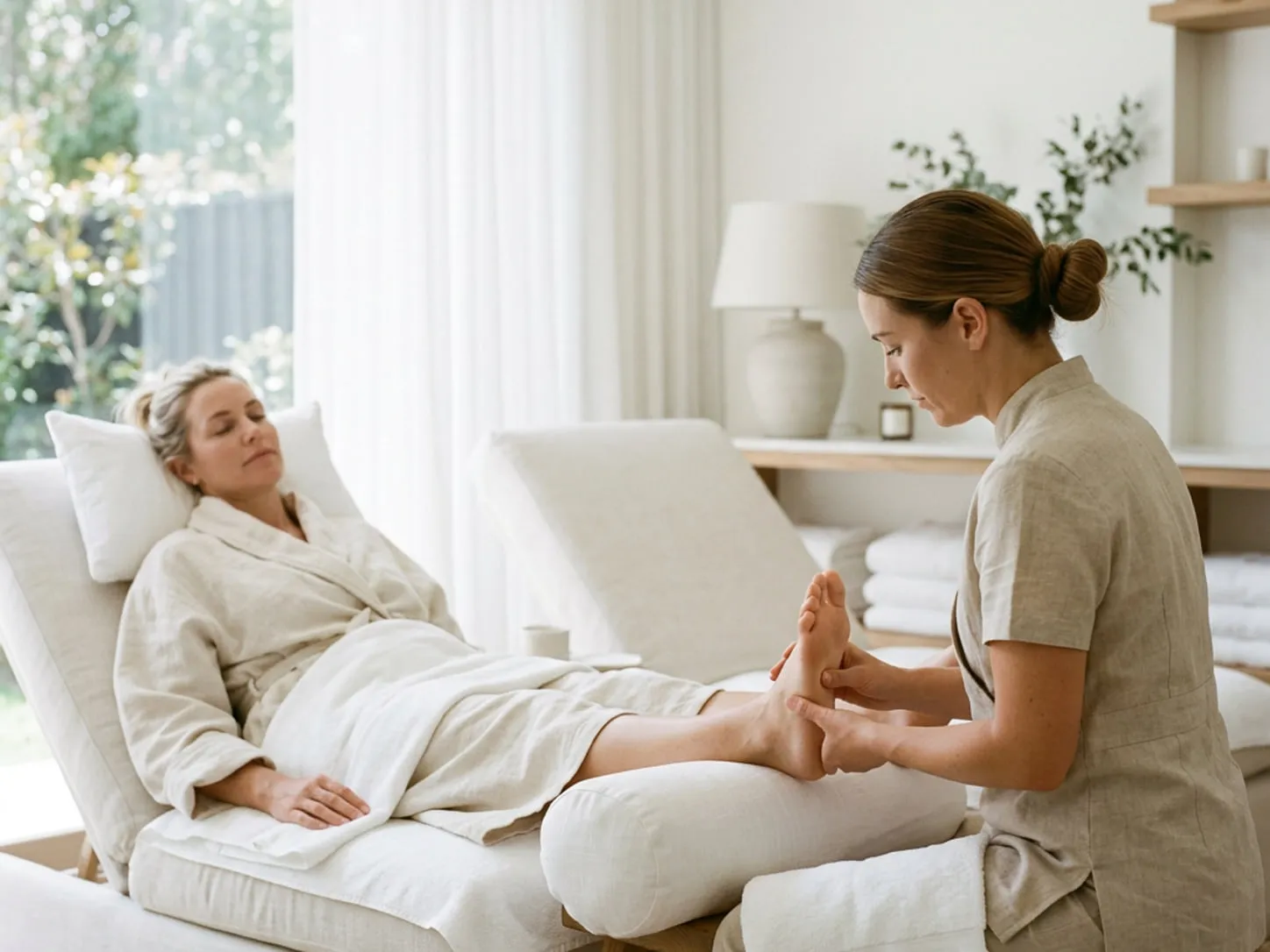
Foot reflexology is firm, deliberate pressure applied to specific points across the soles, arches, heels, ankles and lower legs. The therapist works with thumbs, knuckles and the edges of the hands, holding one spot and leaning into it rather than sliding across the skin the way an ordinary massage does. Traditional charts map those points to other regions of the body, which is where the practice gets its name and most of its controversy.
Booked on its own at LJY, foot reflexology in Hermitage runs 30, 45, 60 or 90 minutes, and it also makes up the first half of both combinations. Nothing comes off but your shoes and socks, and nothing above the knee is touched.
A foot rub covers the surface and moves on. Reflexology returns to the same points and stays there, which is why an hour of it does not feel long.
Where did reflexology come from?
It grew out of traditional Chinese medicine, where pressing mapped points on the body is a very old idea. NCCIH describes traditional Chinese medicine as a system that has evolved over thousands of years, in which practitioners use physical approaches such as acupuncture and tai chi alongside herbal products. Reflexology as practised in American studios sits in that lineage without being any one of those things.
How is it different from a foot rub?
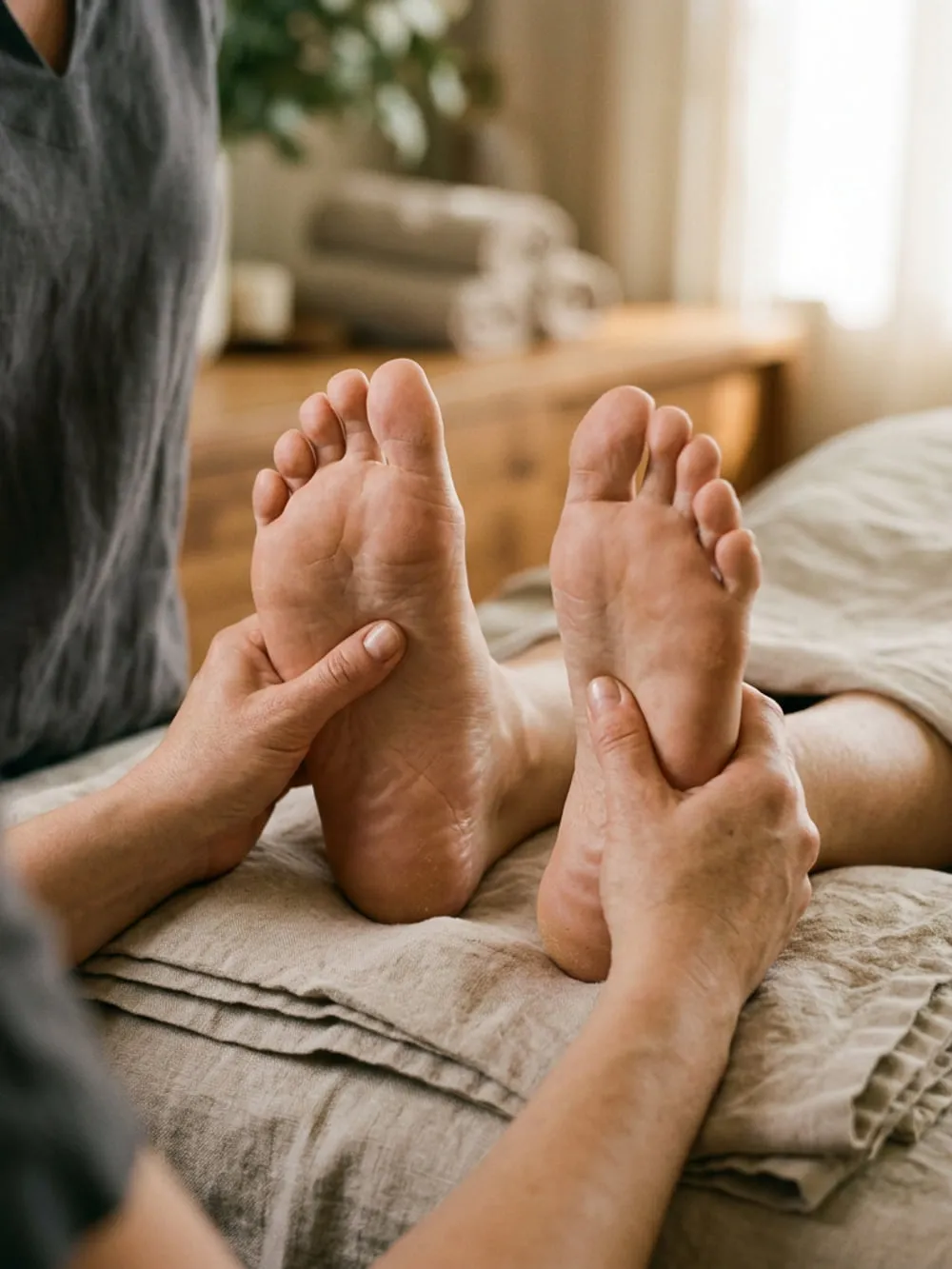
Two things: where the pressure goes, and how long it stays there. The therapist works the arch, the heel pad and the band under the toes in a set sequence, holding each point instead of passing over it. Length is the other difference — 30 minutes is the shortest booking here, and an hour lets the therapist take both feet twice.
Does foot reflexology work?
Nobody can point you at a solid body of evidence for reflexology specifically, and this page will not pretend otherwise. The National Center for Complementary and Integrative Health publishes fact sheets and evidence reviews for massage therapy, acupuncture, tai chi and dozens of other approaches. It does not publish one for reflexology. The research base for reflexology on its own is thin, and saying so is more useful than a paragraph of borrowed statistics.
That matters before you book, because it sets what to expect from the hour: careful pressure work that most people find deeply relaxing, and no medical outcome to plan around. If someone tells you that pressing a point on your foot treats an organ, they are selling you something.
What does the research say about massage in general?
Massage in general has been studied far more thoroughly than reflexology, and the numbers are worth knowing. NCCIH reports that 10.9 percent of U.S. adults used massage therapy in 2022, against 4.8 percent in 2002. On low-back pain, a 2015 review of 25 studies covering 3,096 participants found short-term improvement in both acute and chronic cases, while the reviewers rated the study quality low and concluded they had very little confidence in the finding. On the neck and shoulders, a 2013 review of 12 studies with 757 participants found massage more helpful than inactive comparisons but no better than other active treatments, with shoulder benefits holding only in the short term.
None of those trials studied reflexology. They studied ordinary Western massage therapy delivered on a table, and reading them as though they settle the reflexology question is the mistake this page exists to head off.
How can you tell if a reflexology claim is trustworthy?
Ask which practice the study measured, and how many people were in it. Much of what circulates online cites massage research under a reflexology headline. NCCIH's evidence digest models what a careful summary looks like: it reports a 2014 trial of 228 participants with chronic neck pain in which 60 minute massages given several times a week outperformed shorter or less frequent ones, and it says where the evidence runs out.
What happens in a 60 minute session?
You take off your shoes and socks and settle back; everything else stays on. The therapist starts with broader warming work across the whole foot before pressing firmly into specific spots, then runs from the soles up through the ankles and into the lower legs. Most of the hour is spent below the knee.
Talking is optional, and plenty of people spend the session asleep. The feet often feel warm and a little tender for the rest of the day afterwards, the way a worked muscle does, which is worth knowing if you had planned a long walk.
How do you tell them the pressure is too much?
Give the therapist a number. "That is a 7, take it to a 5" is easier to act on than "a little lighter". Work on the arch and heel can be sharp on a first visit, particularly if you stand for a living, and pressure that makes you brace has gone past doing anything for you. Say so at the time rather than at the desk afterwards.
What will you know by the end of the first visit?
Whether you want to come back. Book the hour rather than the half hour on a first visit and that answer is clear by the time you get up, because 30 minutes ends before most people have settled.
How long should a foot reflexology session be?
Sixty minutes at $80 is the standard, and the one to pick if you are choosing blind. Thirty minutes at $50 suits a returning visitor with a specific complaint and a tight afternoon. Ninety minutes at $120 lets the therapist go over the same ground twice without hurrying.
Stepping from 30 to 60 minutes costs $30 and doubles the time on the clock, which makes it the strongest value move on this row of the menu. Stepping from 60 to 90 costs another $40, which holds the same rate per minute as the hour.
| Length | Price | What it realistically covers |
|---|---|---|
| 30 minutes | $50 | Both feet worked once through; the short repeat booking |
| 45 minutes | $70 | Feet and ankles, with time to slow down on the tight spots |
| 60 minutes | $80 | Feet, ankles and lower legs, unhurried; the standard session |
| 90 minutes | $120 | Two passes at the pressure you settled on, with time to linger |
Who should ask a doctor before booking?
Anyone pregnant, anyone with a diagnosed blood clot or a history of clots, and anyone with a recent fracture, sprain or surgery involving the foot, ankle or leg. Ask your own doctor rather than the front desk, and mention the appointment when you do. Nothing on this page is medical advice.
NCCIH rates the overall risk of harm from massage as low, while listing rare reports of a blood clot, nerve injury or bone fracture, some of them following vigorous styles of massage. Reflexology stays below the knee, which narrows that picture without removing the reason to ask.
- Pregnancy — ask your doctor or midwife first, and tell the therapist when you arrive.
- A diagnosed deep vein thrombosis or a history of clots — a doctor's question before any massage or reflexology booking.
- A recent fracture, sprain or surgery on the foot, ankle or lower leg — wait for your doctor's clearance.
- Diabetes with reduced sensation in the feet, or any open sore, wound or skin infection where the work would go.
- Cancer treatment — ask the team treating you. NCCIH notes that therapists often need to use less pressure than usual in areas made sensitive by cancer or its treatment.
Foot reflexology or a table massage?
Feet and legs, book reflexology. Back and shoulders, book the table. Both are $80 at 60 minutes, so cost does not decide it, and the two treatments feel nothing alike once you are in the room.
If you cannot choose, the combinations exist for that. Combination A gives you 30 minutes of foot work followed by 30 minutes on the table for $90. Combination B swaps the table for the chair at $80, which fits when the complaint is feet plus a stiff neck. Both are fixed at an hour, and the full comparison sits on the menu guide.
Questions people ask
How much is foot reflexology in Hermitage, TN?
At LJY Reflexology it is $50 for 30 minutes, $70 for 45 minutes, $80 for 60 minutes and $120 for 90 minutes. Combination A pairs 30 minutes of foot work with 30 minutes on the table for $90, and Combination B pairs it with chair work for $80.
Does foot reflexology hurt?
It should not. Work on the arch and heel can feel sharp on a first visit, especially if you stand for a living, but pressure that makes you brace or hold your breath has gone too far. Give the therapist a number from 1 to 10 and correct it out loud as they go.
Do I have to undress for foot reflexology?
No. Shoes and socks come off and everything else stays on, because the work is done on the feet, ankles and lower legs. If you would rather keep your clothes on and stay in a chair, chair massage starts at $35 for 20 minutes.
How long should a foot reflexology session be?
Sixty minutes at $80 is the standard first booking. Thirty minutes at $50 works better as a repeat visit, and 90 minutes at $120 slows the whole session down. The step from 30 to 60 minutes costs $30 and doubles the time.
Is there scientific evidence that reflexology works?
Not much that is specific to reflexology. NCCIH publishes evidence reviews for massage therapy, acupuncture and tai chi, but not for reflexology, and there is no comparable body of trials behind it. Massage therapy has been studied far more thoroughly, and those findings should not be read as reflexology findings.
What is the difference between reflexology and a foot massage?
Reflexology holds firm pressure on specific spots across the soles, arches, heels and ankles in a set order. A general foot massage covers the surface and keeps moving. Reflexology sessions are also longer, running 30 to 90 minutes rather than a few minutes tacked onto something else.
Can I have foot reflexology while pregnant?
Ask your doctor or midwife before booking, and tell the therapist when you arrive. The decision belongs with the person managing your pregnancy rather than with a front desk. The same goes for a diagnosed blood clot, a recent fracture, or surgery on the foot or leg.
Can I book foot reflexology and a table massage together?
Yes, as Combination A: 30 minutes of foot work followed by 30 minutes on the table, $90 for the hour. Combination B is the chair version at $80. Both are fixed at 60 minutes. Book on Square or call (615) 835-2603.
Sources
- NCCIH — Massage Therapy: What You Need To Know
- NCCIH — Traditional Chinese Medicine: What You Need To Know
- NCCIH — Massage Therapy for Health: What the Science Says
- NCCIH — 6 Things To Know About Massage Therapy for Health Purposes
Written and fact-checked by the LJY Reflexology editorial team against the primary sources above. Where the evidence for a claim is thin, this page says so rather than borrowing a stronger finding from a different treatment.
Massage therapy is a licensed profession in Tennessee, regulated by the Tennessee Massage Licensure Board, which keeps a public register you can search before booking anywhere.
This page is for general education only and is not medical advice. Talk with your healthcare provider about what is right for you.
Book the hour and set the pressure
Foot reflexology in Hermitage, at four lengths
Firm pressure held on specific spots of the feet, ankles and lower legs at 3877 Lebanon Pike: $50 for 30 minutes, $70 for 45, $80 for 60 and $120 for 90. Shoes and socks off, everything else on. Open seven days, booked on Square or on (615) 835-2603.
LJY Reflexology · 3877 Lebanon Pike, Hermitage, TN 37076 · (615) 835-2603 · Mon, Wed – Sat 10 AM – 8 PM · Sun 12 – 7 PM · Tue 11 AM – 4 PM.
Keep reading
Foot Reflexology on the menu
30, 45, 60 and 90 minutes, $50 through $120, booked on Square.
Read
Choosing between foot, table and chair
The whole menu compared, with what each length buys you.
Read
Foot massage for Nashville
The same treatment, written for people driving in from the city.
Read
Combination A — foot plus table
30 minutes of foot work followed by 30 minutes on the table, $90 for the hour.
Read